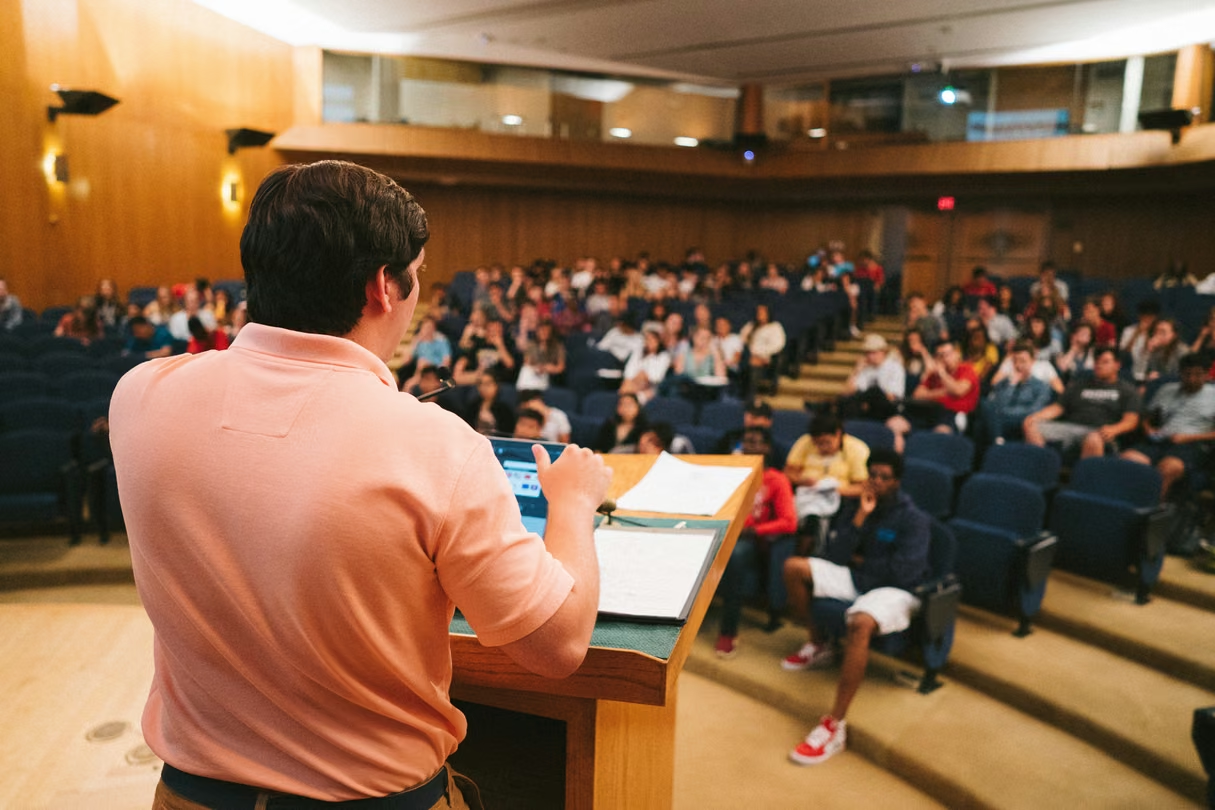
Today's computing power and the vast availability of big data are propelling the field of artificial intelligence (AI) at unprecedented speed, marking a new historical juncture between science, ethics, and society. Through an integrated format of lectures, industry guest speakers, guided discussions, film and documentary screenings, and a week-long team project, this course enables you to explore both the scientific foundations of AI, from its early conceptual origins to emerging frontiers, and its ethical, social, and governance implications.
The week is built around a team challenge. Working in a group with mentor support, you will move from problem discovery to a working prototype. This includes framing a real-world problem, testing your idea against a data ethics canvas, developing a concept sheet and storyboard, building an “AI for Good” solution, drafting a “Responsible AI” statement, and pitching your work to a panel of industry practitioners on the final day. Along the way, you will hear from AI product leaders and responsible AI practitioners, examine how data quality and design choices shape bias and fairness, experiment with human-AI collaboration as a creative partnership, and step off campus to place this technological moment within a longer historical frame.
By testing simple AI models, analyzing real-world use cases, and building something of your own, you will gain practical insight into how AI systems function, how they shape decision-making, and how responsible innovation can be achieved.
Program Dates
June 20–26, 2027
June
Program Format & Subject Areas
As a student in the Artificial Intelligence Academy, you'll spend your days immersed in a blend of lectures, industry sessions, hands-on labs, team studio time, and evening film discussions. Throughout the week, you'll have the opportunity to explore the following subject areas:
- The science of AI
- The ethics of AI
- Data, bias, and fairness
- AI, inequality, and responsible governance
- Human-AI collaboration and creativity
- AI for good in industry practice
How You'll Benefit
#1
Define AI from a socio-technical perspective.
#2
Summarize current scientific innovations and limitations across industry and government use cases.
#3
Identify ethical considerations with the use of AI (e.g., bias, transparency, explainability, privacy, security, and accountability).
#4
Evaluate how data quality, data selection, and design choices shape fairness in AI systems.
#5
Examine how AI intersects with inequality, and how responsible governance shapes who benefits from these technologies.
#6
Apply responsible AI practices to your own work, including a data ethics canvas and a written Responsible AI Statement.
#7
Collaborate with AI tools as a creative and analytical partner rather than as a black box.
#8
Design, prototype, and pitch an AI for Good solution to a panel of industry practitioners.
#9
Explore career pathways in AI across industry, government, and research.
All in all, I fell in love with the program. I got to meet so many amazing people, not only from the D.C. area but all around the country.
 Zeyneb Sekin Student
| Time | Activity |
|---|---|
| 7:00 a.m.–9:00 a.m. | Breakfast |
| 9:00 a.m.–12:00 p.m. | Lecture/Off-Site Visit/Lab |
| 12:00 p.m.–1:30 p.m. | Lunch |
| 1:30 p.m.–5:00 p.m. | Lecture/Off-Site Visit/Lab |
| 5:00 p.m.–7:00 p.m. | Dinner |
| 7:00 p.m.–9:00 p.m. | Capstone Project |
| 9:00 p.m.–11:00 p.m. | Student Activities/Residential Life Supervision |
In the Artificial Intelligence Academy, you'll attend academic programming between 9:00 a.m. and 9:00 p.m. during the weekdays, which will include lectures, guest speakers, hands-on activities, group discussions, and off-site visits. At the end of the day, you'll have opportunities to participate in optional cocurricular events, free time, and residential living activities until curfew.

We’re here to help
Whether you have questions about our programs, events, or general inquiries, you can reach us in the way that works best for you.
Summer Programs for High School Students Office
Office Hours: 9:00 a.m.–5:30 p.m. ET, M–F
Email: highschool@georgetown.edu
Phone: (202) 687-7087
Admissions Office Mailing Address
Georgetown University
Summer Programs for High School Students
Admissions Office
111 Massachusetts Ave NW
Washington, DC 20001
Summer Hoya Office
Office Hours: Sunday–Saturday. 8:00 a.m.–10:00 p.m., end of May through August
Email: summerhoya@georgetown.edu
Phone: (202) 687-9786
University Information Services (UIS)
Office Hours: Monday–Friday, 8:30 a.m.–5:00 p.m. ET
Email: help@georgetown.edu
Phone: (202) 687-4949
University Registrar’s Office (OUR)
Office Hours: Monday–Friday, 9:00 a.m.–5:00 p.m. ET
Email: univregistrar@georgetown.edu
Phone: (202) 687-4020
Non-Credit Student Accounts (NCSA)
Office Hours: Monday–Friday, 9:00 a.m.–5:00 p.m. ET
Email: noncreditaccounts@georgetown.edu
Phone: (202) 687-7696
Office of Revenue & Receivables
Office Hours: Monday–Friday, 9:00 a.m.–5:00 p.m. ET
Email: studentaccounts@georgetown.edu
Phone: (202) 687-7100